Key Takeaways
|
Ask five parents at a Mussafah playground what the difference is between a nursery and a preschool, and you'll likely get five different answers, and all of them will sound fairly convincing.
That's because the four terms get used loosely, even by schools themselves. Some nurseries call themselves preschools.
Some daycares run a full early-years curriculum. The confusion isn't a parenting gap; it's simply inconsistent terminology across the industry.
This article breaks down what each stage actually means, who it's for, and how they differ in daily routine, learning focus, and school readiness.
It also looks at how families in Abu Dhabi and Mussafah mostly think about the transition from one stage to the next.
Table Of Content1. Why Are Daycare, Nursery, Preschool, and Kindergarten Often Confused?
2. What is Daycare?
3. What is a Nursery?
4. What is Preschool?
5. What is Kindergarten?
6. How Do Age and Developmental Needs Differ Across Programs?
7. How Each Programme Builds School Readiness?
8. How Do Children Move From One Stage to the Next?
9. A Few Things Worth Remembering
10. FAQ: What is the Difference Between Daycare, Nursery, Preschool, and Kindergarten?
Why Are Daycare, Nursery, Preschool, and Kindergarten Often Confused?
Part of the confusion comes from geography.
In the UK, "nursery" often covers the whole 0–5 age range.
In the US, "daycare" is the umbrella term, and "preschool" is a specific programme within it.
In the UAE, schools tend to follow their own internal naming, shaped by the curriculum they follow (British, American, IB, or a blend).
So rather than memorising strict definitions, it helps to think of these four stages as points on a single early-years journey, one that moves gradually from care towards structured learning, and eventually towards formal schooling.
Daycare vs Nursery vs Preschool vs Kindergarten: Quick Comparison Table
| Stage | Age | Main Focus | Setting |
|---|---|---|---|
| Daycare | 45 days – 4 years | Supervision, care, daily routine | Full-day, flexible hours |
| Nursery | 1 – 3 years | Group play, early socialisation | Half-day or full-day |
| Preschool | 3 – 5 years | Play-based learning, communication | Structured sessions, term-based |
| Kindergarten | 4 – 6 years | School readiness, early academics | Structured, classroom-style |
Ages can vary by school and curriculum; always confirm with the institution you're considering.
What is Daycare?
Daycare is built around one core idea: keeping children safe, cared for, and comfortable while parents are at work or otherwise occupied.
Daycares mostly accept children from just a few weeks old and run for extended hours, often matching a full working day.
That doesn't mean daycare is "just babysitting", though.
A good daycare in Abu Dhabi still includes age-appropriate activities like songs, sensory play, storytime, and outdoor time woven around feeding, nap, and rest schedules.
The emphasis is on routine and wellbeing first, with learning happening naturally through play and interaction rather than through a set curriculum.
Daycare perfectly suits working parents who need flexible, full-day coverage for infants and toddlers.
What is a Nursery?
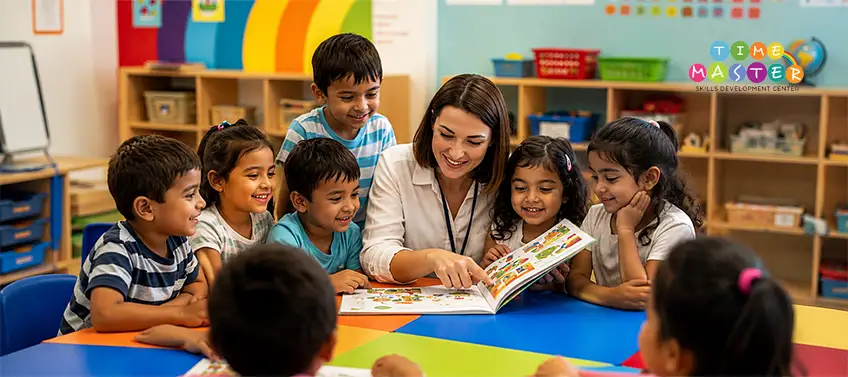
Nursery sits between daycare and preschool. It's usually where a child has their first real taste of a group environment, sitting in a circle, sharing toys, following simple instructions from someone other than a parent.
Nursery in Abu Dhabi focuses on activities that lean heavily on play: sensory tables, building blocks, music and movement, and lots of unstructured exploration.
The nursery curriculum (where one exists) is light-touch, designed to build confidence and basic social skills rather than academic ones.
For many families in Abu Dhabi and Mussafah, nursery is the gentle first step away from home before a child moves into a more structured preschool setting.
Nurseries in Mussafah and Abu Dhabi suit toddlers who are ready for short bursts of group interaction but aren't yet ready for a structured school day.
What is Preschool?
Preschool is where early learning starts to take a more deliberate shape.
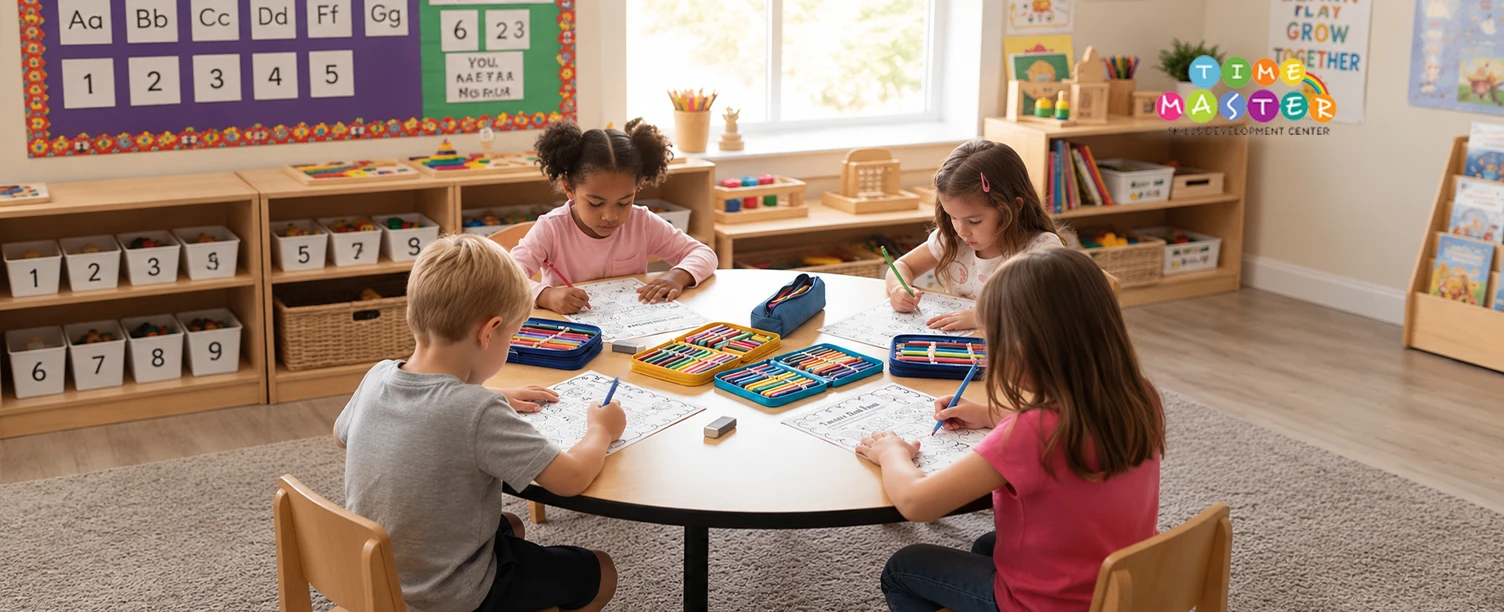
Children are usually between three and five, and the preschool curriculum introduces letters, numbers, shapes, and early problem-solving, always through play rather than worksheets or rote memorisation.
From creative play to hands-on learning, preschool activities for children in Abu Dhabi can help develop communication, motor skills, curiosity, and social confidence.
This is also the stage where children build the social and emotional skills that formal schooling assumes they already have: taking turns, following a daily schedule, working in small groups, and managing their own belongings.
The preschool programmes in Abu Dhabi and Mussafah are designed around exactly this balance: enough structure to build habits, enough play to keep learning enjoyable.
Preschool is for children aged three to five who are ready for a more consistent daily structure and early academic exposure.
Parents can make a more informed choice by understanding the key features of a high-quality preschool, from teaching methods and safety to teacher support and learning environments.
What is Kindergarten?
Kindergarten is the bridge into formal education.
It usually applies to children aged four to six, and the classroom starts to resemble "real school" with assigned seating, a timetable, and a curriculum that moves towards reading readiness, basic maths concepts, and independent task completion.
Kindergarten still uses play and hands-on activities, but the goal shifts noticeably towards kindergarten readiness: can the child sit through a lesson, follow multi-step instructions, and work independently for short stretches?
These are the building blocks that primary school will expect from day one.
Kindergarten suits children preparing to enter Grade 1 or Year 1 within the next year.
How Do Age and Developmental Needs Differ Across Programs?
Each programme is designed around a different stage of early childhood development, so understanding the common age range and developmental focus can help parents choose the most suitable option for their child.
Age & Developmental Focus Comparison
| Stage | Age Range | Developmental Focus |
|---|---|---|
| Daycare | 45 days – 4 years | Routine, comfort, sensory exploration |
| Nursery | 1 – 3 years | Social interaction, early communication |
| Preschool | 3 – 5 years | Independence, communication, early literacy, and numeracy |
| Kindergarten | 4 – 6 years | Classroom behaviour, pre-reading, pre-maths |
Every child develops at their own pace, so these ranges are a general guide rather than a strict rule. A child who needs a little longer in preschool before moving to kindergarten isn't behind; they're simply following their own timeline.
Thinking about which stage fits your child right now?
Find the best early learning programmes in Abu Dhabi and Mussafah, which are grouped by age and developmental stage, so you can see exactly where your child would sit.
How Each Programme Builds School Readiness?
Each programme supports children at a different stage of learning, helping them develop the skills, confidence, independence, and social abilities needed to transition successfully to the next level of education.
Learning Goals and School Readiness Comparison
| Stage | Primary Learning Goal | School Readiness Contribution |
|---|---|---|
| Daycare | Safety, care, daily rhythm | Builds trust in a group setting |
| Nursery | Early social skills | Introduces sharing, turn-taking |
| Preschool | Communication, early concepts | Builds classroom stamina and curiosity |
| Kindergarten | Structured early academics | Direct preparation for primary school |
Dubai's early childhood sector has been growing quickly, which says something about how many families now see these early years as genuinely important rather than optional.
According to figures from Dubai's Knowledge and Human Development Authority, enrolment at private early childhood centres rose by 8% in the 2024–25 academic year, with 38 new centres opening to meet demand.
It's a useful reminder that structured early learning, at whatever stage, is increasingly seen as a real foundation for later schooling, not just childcare.
Helping children practise daily routines, communicate their needs, and become comfortable with new environments can support preschool readiness for children.
How Do Children Move From One Stage to the Next?
There's no single "correct" path.
Some children start in daycare as infants and progress naturally through nursery, preschool, and kindergarten at the same institution. Others join at nursery or preschool age, having been cared for at home until then.
Both routes are completely normal.
What matters more than the label is consistency: a calm daily routine, warm and familiar caregivers, and activities matched to your child's current stage of development, not their age on paper.
If you'd like to see how this progression works in practice, choose the best preschool in Mussafah and visit directly to walk through the daily routines, activities, and developmental support on offer at each stage.
A Few Things Worth Remembering
-
Terminology differs between schools and countries; always ask what a specific programme actually includes rather than relying on the name alone.
-
No stage is "better" than another; each serves a different developmental purpose.
-
Academic expectations for daycare, nursery, and preschool-age children should stay light; play is still the main way young children learn.
-
There are no guarantees in child development. Consistency and a supportive environment matter far more than ticking age-based boxes on a schedule.
FAQ's
.webp)